


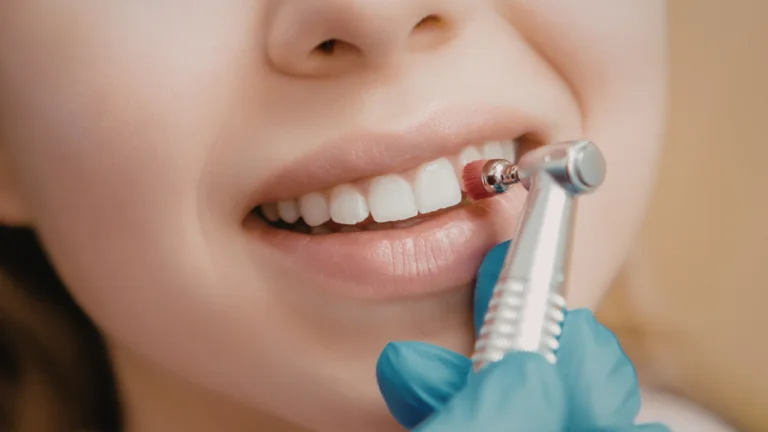
Fluoride varnish is a painless, evidence-backed preventive procedure applied in minutes. Who needs it, how often it is repeated, and what to do afterwards.
Fluoride varnish is one of the most practical procedures in preventive dentistry: it takes a few minutes, needs no anaesthetic and is tolerated without difficulty even by children. Most patients, though, do not know exactly what it is or why it is done.
What varnish is, and how it differs from toothpaste
Varnish is a resin-based material containing fluoride at high concentration. Painted onto the tooth, it sets on contact with saliva and remains in place for hours, slowly releasing fluoride during that time.
The fluoride in toothpaste is washed away within seconds; that in varnish forms a reservoir on the surface. The difference lies in contact time more than concentration, and that is what determines its effectiveness.
How it is applied
The tooth surface is cleaned and dried first. The varnish is painted on in a thin layer with a small brush. The procedure usually takes two or three minutes for the whole mouth. There is no anaesthetic, no cutting, and a child can remain sitting up.
Afterwards the teeth may look slightly yellow and feel rough. This is expected and disappears with brushing the next day.
What to observe afterwards
- Do not brush for at least four to six hours
- Avoid hard and sticky food for the rest of the day
- Limit hot drinks; they dissolve the varnish faster
- Choose soft food, and wait a few hours if you can
Applying it in the evening and skipping that night's brushing keeps the varnish in place longest. The normal routine resumes the next morning.
Who it is recommended for
Varnish is not applied routinely to everyone; the decision follows a risk assessment. In a low-risk adult the added benefit is limited. In high-risk groups it is one of the best-value preventive procedures available.
- Children with a history of decay in the primary teeth
- Children with newly erupted permanent molars
- Orthodontic patients of any age
- Patients with a dry mouth or taking multiple medicines
- Adults with root surfaces exposed by gum recession
- Patients in whom white spot lesions have been found
How often it is repeated
The standard approach is twice a year, alongside six-monthly check-ups. In high-risk patients the interval is shortened to three months; four applications a year is considered safe.
The frequency is not a fixed prescription. As risk falls, the interval lengthens. At each visit we therefore look not only at the teeth but at habits and the list of medicines.
Is it safe, and how much fluoride is involved?
The fluoride concentration in varnish is high, but the total amount applied is very small and most stays on the tooth surface. The quantity swallowed is far below daily safe limits, which is why it can be applied from one year of age.
Because it contains colophony, colophony-free products are preferred in patients with a known allergy to pine resin. Application is postponed if there are ulcers or active infection in the mouth.
How it differs from a fissure sealant
The two are often confused but do different jobs. A fissure sealant fills the deep grooves on the biting surface of the back teeth with a flowable material, creating a physical barrier that lasts for years.
Varnish is not a barrier; it delivers fluoride to all tooth surfaces and its effect fades within weeks. In most children the two are planned together: the sealant protects the biting surface, the varnish the rest.
Is it used in adults too?
Varnish is known as a children's procedure, but it has a clear place in adults too. The root surface exposed by gum recession is far softer than enamel and is affected by acid much faster; root caries is among the commonest problems in later life.
In patients who have had radiotherapy to the head and neck, in older people on many medicines, and in those with recurrent decay at crown and bridge margins, varnish becomes part of the routine. A three-month interval is usually more appropriate for these groups.
Is it enough on its own
It is not. Varnish is an addition on top of regular brushing and a reasonable diet. In a child eating something sugary five times a day and not brushing, two applications a year will not change the outcome.
Used properly it makes a measurable difference: studies show regular application markedly reduces the development of decay in children. For a small, inexpensive and painless procedure, that is a serious return.















































































